

Table of Contents Show
Six months ago, I watched my website’s traffic plummet by 40% overnight. Like many SEO professionals, I was caught off-guard by Google’s AI Overviews rollout. The traditional playbook suddenly felt obsolete, and I realized that mastering AI Overviews optimization had become critical for survival. According to recent data from BrightEdge, AI now influences over 58% of organic search results, fundamentally changing how users discover and consume content.
The harsh reality? Many businesses are experiencing the same pain points: declining click-through rates, reduced organic traffic, and the unsettling feeling that traditional keyword rankings no longer guarantee success. The emergence of AI-powered search features like Google’s SGE (Search Generative Experience) and Bing Copilot has created a new battlefield where only the strategically optimized survive.
AI Overviews optimization is the process of structuring and crafting content specifically to appear in AI-generated summaries and quick answers that now dominate search results. It’s not just about ranking anymore—it’s about being the source AI trusts and references.
Comprehensive AI Overviews Optimization Guide for SEO
Detailed Definition of AI Overviews Optimization and Its Role in Modern Search
AI Overviews optimization represents a paradigm shift in how I approach content creation and SEO strategy. Unlike traditional SEO that focused primarily on keyword density and backlinks, AI Overviews optimization requires understanding how artificial intelligence systems like Google’s SGE, Bing Copilot, and ChatGPT-powered search features consume, interpret, and synthesize information.
When I optimize for AI Overviews, I’m essentially training my content to become the preferred source for AI systems to reference when generating comprehensive answers to user queries. This involves structuring information in ways that AI can easily parse, understand context, and extract relevant snippets for quick answers.
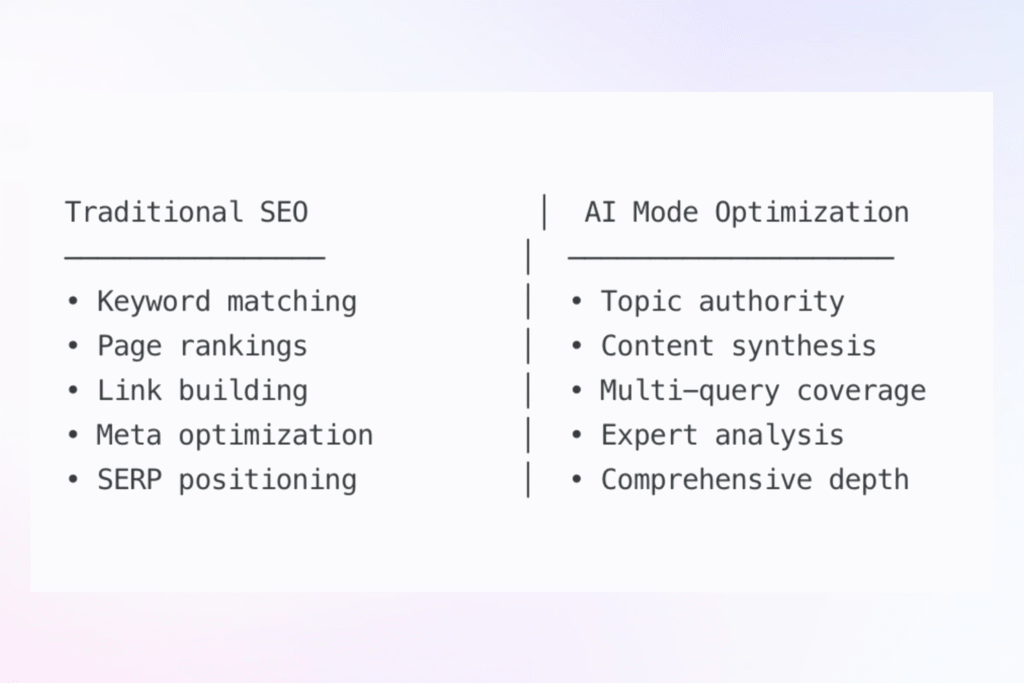
Key Differences Between Traditional SEO and AI Overview SEO
The fundamental difference lies in the target audience. Traditional SEO optimized for human readers and search engine crawlers, while AI Overviews optimization targets the AI systems that now act as intermediaries between search engines and users.
Traditional SEO focused on keyword placement and density, whereas AI overview SEO emphasizes semantic relationships, entity connections, and contextual relevance. I’ve learned that AI systems value comprehensive, authoritative content that directly answers user intent rather than content optimized solely for ranking algorithms.
Benefits of AI Overview Optimization for Websites and Brands
Through my experience implementing AI Overviews optimization strategies, I’ve observed significant benefits including increased brand authority, higher-quality traffic, and improved user engagement metrics. When your content consistently appears in AI-generated summaries, it establishes your brand as a trusted authority in your field.
The traffic quality improvement is particularly noteworthy—users who arrive through AI Overview references tend to have higher engagement rates and conversion potential because they’ve already been pre-qualified by the AI’s content curation process.
How AI Uses Content to Generate Summaries and Quick Answers
AI systems employ sophisticated natural language processing to analyze content structure, extract key information, and synthesize comprehensive answers. I’ve observed that AI particularly values content with clear hierarchical structure, factual accuracy, and comprehensive coverage of topics.
The AI evaluation process considers multiple factors including content freshness, author expertise, source credibility, and how well the content addresses specific user intents. Understanding this process has been crucial in developing effective optimization strategies.
Essential Components for AI Overviews Optimization
Optimizing Content Structure: Q&A Format, Short Paragraphs, Lists, and Clear Headers
Content structure forms the foundation of successful AI Overviews optimization. I structure my content using clear question-and-answer formats that AI systems can easily identify and extract. Short paragraphs of 2-3 sentences work exceptionally well because they provide digestible information chunks that AI can process efficiently.
Bullet points and numbered lists are particularly effective because they allow AI to extract specific points without losing context. I always use descriptive headers that clearly indicate the content’s purpose and make it easy for AI to understand the information hierarchy.
Strategic Use of Primary and Secondary Keywords with User Intent Context
Keyword integration for AI Overviews optimization requires a more sophisticated approach than traditional SEO. I focus on semantic keyword clusters rather than exact-match keywords, ensuring that my content covers related concepts and entities that AI systems associate with the primary topic.
The key is understanding search intent behind queries and incorporating keywords naturally within contextually relevant content. I use tools like SEMrush and Ahrefs to identify semantic keyword opportunities and long-tail variations that AI systems commonly reference.
Implementing E-E-A-T Principles for Content Credibility
Experience, Expertise, Authoritativeness, and Trustworthiness (E-E-A-T) are crucial for AI Overviews optimization. I consistently demonstrate my expertise through detailed, accurate content that showcases real-world experience and practical insights.
Building authoritativeness requires consistent content creation, industry recognition, and establishing thought leadership in your field. I achieve this through regular publication of in-depth guides, case studies, and original research that other industry professionals reference and cite.
Leveraging Entity SEO for AI Understanding
Entity SEO helps AI systems understand the relationships between concepts, people, places, and things mentioned in your content. I use structured data markup to clearly define entities and their relationships, making it easier for AI to understand context and connections.
This involves identifying key entities in your industry and ensuring your content establishes clear relationships between these entities and your brand or expertise areas.
Regular Content Updates for Freshness and Reliability
AI systems heavily favor fresh, regularly updated content because it indicates reliability and current relevance. I maintain a content update schedule that ensures my most important pages receive regular updates with new information, recent statistics, and current examples.
This doesn’t mean completely rewriting content—often, adding recent case studies, updating statistics, or expanding sections with new insights is sufficient to maintain content freshness.
Page Speed and User Experience Optimization
Technical performance directly impacts AI Overviews optimization success. I ensure all pages load quickly, provide excellent mobile experiences, and meet Core Web Vitals standards because AI systems consider user experience signals when evaluating content quality.
Page speed optimization includes image compression, minimizing JavaScript, using content delivery networks, and implementing efficient caching strategies.
Strategic AI Overviews Optimization Approaches
Researching Long-tail and Conversational Keywords for AI Search Intent
AI-powered search has increased the importance of conversational and long-tail keywords. I use tools like AnswerThePublic and Google’s “People Also Ask” features to identify natural language queries that users ask AI systems.
Voice search optimization has become increasingly important as users ask AI assistants complete questions rather than typing fragmented keyword phrases. I optimize for these natural language queries by incorporating them into my content structure and headers.
Creating FAQ and How-To Sections with Detailed Structured Data
FAQ sections are goldmines for AI Overviews optimization. I create comprehensive FAQ sections that address common user questions and implement proper schema markup to help AI systems understand and extract this information.
How-to content performs exceptionally well in AI overviews because it provides step-by-step information that AI can easily format and present to users. I structure these sections with clear numbering, descriptive headers, and actionable instructions.
Writing Natural, Understandable Content While Avoiding Keyword Stuffing
AI systems are sophisticated enough to detect and penalize keyword stuffing. I focus on writing naturally while incorporating keywords contextually. The goal is creating content that reads well for humans while providing clear signals to AI about the topic and expertise level.
This approach requires understanding user intent and creating content that genuinely helps users rather than simply targeting search algorithms.
Using AI and SEO Tools for Content Analysis and Optimization
I leverage various AI-powered tools including ChatGPT for content ideation, SEMrush for keyword research and competitive analysis, and specialized AI content optimization tools to analyze and improve my content’s AI-friendliness.
These tools help identify gaps in content coverage, suggest related topics to include, and provide insights into how AI systems might interpret and use my content.
Building Quality Links and Authority for Website Credibility
Link building for AI Overviews optimization focuses on quality over quantity. I prioritize earning links from authoritative sources in my industry because AI systems consider these signals when evaluating content credibility.
The link building strategy includes creating linkable assets like original research, comprehensive guides, and tools that naturally attract high-quality backlinks from relevant sources.
Implementing Data-Driven Content Update Strategies
I use analytics data to identify content that performs well in AI overviews and patterns that lead to successful optimization. This includes monitoring which content formats, structures, and topics consistently appear in AI-generated summaries.
Regular analysis of user behavior data helps refine content strategies and identify opportunities for improvement in AI Overviews optimization.
Best Practices for AI Overviews Optimization Content Structure
Organizing Articles with Clear Subheadings, Short Paragraphs, and Bullet Points
Content organization directly impacts AI’s ability to extract and use your information. I structure articles with a clear hierarchy using H2 and H3 tags that describe the content’s purpose. Short paragraphs make information more digestible for both AI systems and human readers.
Bullet points are particularly effective for listing benefits, steps, or key points because AI can easily identify and extract individual items for use in summaries and quick answers.
Writing Quick Answer Summaries at Article Beginning
I include concise summaries at the beginning of articles that directly answer the primary question or provide key takeaways. These “quick answer” sections are frequently selected by AI systems for overview generation because they provide immediate value to users.
These summaries should be 2-3 sentences that capture the essential information while encouraging users to read the full article for comprehensive details.
Implementing Schema Markup for FAQ and How-To Content
Structured data markup is crucial for AI Overviews optimization. I implement FAQ schema for question-and-answer sections and How-To schema for instructional content. This markup helps AI systems understand content structure and purpose.
Proper schema implementation increases the likelihood of content being featured in AI overviews and provides clear signals about content type and relevance.
Using Multimedia to Support Content and Enhance User Experience
I incorporate relevant images, videos, and infographics that support and enhance the textual content. AI systems consider multimedia elements when evaluating content comprehensiveness and user experience quality.
Alt text for images should include descriptive long-tail keywords that provide context about the visual content while supporting the overall topic relevance.
Important Technical AI Overviews Optimization Considerations
Optimizing Page Speed and Mobile-Friendly Design
Technical performance is fundamental to AI Overviews optimization success. I ensure all pages meet Google’s Core Web Vitals standards and provide excellent mobile experiences because AI systems factor technical performance into content evaluation.
Mobile optimization is particularly important as voice search and AI assistant usage predominantly occurs on mobile devices.
Ensuring Complete and Accurate Indexing of Important Pages
I regularly audit my website’s indexing status to ensure important pages are properly crawled and indexed. AI systems can only reference and extract from content that search engines have successfully indexed.
This includes monitoring Google Search Console for indexing issues and ensuring critical pages aren’t blocked by robots.txt or other technical barriers.
Implementing HTTPS and Security Standards
Security is a ranking factor that AI systems consider when evaluating content credibility. I ensure all websites use HTTPS and maintain proper security certificates because these signals contribute to overall trustworthiness assessments.
Additional security measures like regular updates and malware monitoring help maintain the site reputation that influences AI system trust.
Ensuring Structured Data Accuracy and Alignment
Structured data must accurately reflect the visible content to avoid penalties or reduced trust from AI systems. I regularly audit schema markup to ensure it properly represents the actual content and doesn’t include misleading information.
Misaligned structured data can result in AI systems losing trust in your content and reducing the likelihood of inclusion in overviews.
Measuring Effectiveness and Continuous Improvement
Key Metrics to Track: AI Overview Positions, Traffic, Click-Through Rates
I monitor several specific metrics to evaluate AI Overviews optimization success including appearances in AI-generated summaries, traffic from AI overview references, and engagement metrics from users who arrive through AI-powered search features.
Click-through rates from AI overviews often differ from traditional search results, requiring adjusted expectations and optimization strategies based on user behavior patterns in AI-mediated search experiences.
Tools for Monitoring AI Overview SEO Performance
Google Search Console provides valuable insights into how content performs in various search features, including AI overviews. I use SEMrush and Ahrefs to monitor keyword performance and track appearances in AI-generated content.
Specialized AI SEO tools are emerging that provide specific insights into AI overview performance and optimization opportunities.
Analyzing AI-Provided Data for Strategy Refinement
I regularly analyze the data that AI systems provide about user search behavior and content performance to refine optimization strategies. This includes studying which content formats and topics consistently perform well in AI overviews.
Understanding trending questions and search patterns helps inform content creation and optimization priorities for maximum AI overview visibility.
Future Trends in AI Overviews Optimization
AI Development in Content Understanding and Generation
The sophistication of AI content understanding continues advancing rapidly. I anticipate AI systems will become even better at understanding context, intent, and content quality, making expertise and authoritativeness increasingly important for optimization success.
Future AI developments will likely emphasize real-time content evaluation and dynamic optimization requirements that adapt to changing user needs and search patterns.
Impact of AI on Traditional SEO Methods
Traditional SEO tactics like keyword stuffing and manipulative link building are becoming less effective as AI systems become more sophisticated at detecting and penalizing these practices.
The future of SEO lies in creating genuinely valuable, expertly crafted content that serves user needs while demonstrating clear expertise and authority in specific subject areas.
Preparing for AI Algorithm Changes and Search Evolution
Staying competitive in AI-powered search requires continuous learning and adaptation. I maintain flexibility in optimization strategies and focus on fundamental principles like content quality, user value, and technical excellence that remain important regardless of specific algorithm changes.
Building sustainable SEO strategies means focusing on long-term value creation rather than exploiting temporary algorithm weaknesses or shortcuts.
AI Overviews Optimization: Your Path to SEO Success
Summary of AI Overviews Optimization Importance and Related SEO Strategies
AI Overviews optimization has fundamentally changed the SEO landscape, requiring new approaches to content creation, technical optimization, and user experience design. Success requires understanding how AI systems evaluate and extract content while maintaining focus on creating genuine value for users.
The strategies I’ve outlined—from content structure optimization to technical performance enhancement—work together to create a comprehensive approach that positions your content for success in AI-powered search environments.
Encouraging Continuous Implementation and AI Trend Adaptation
The AI search landscape continues evolving rapidly, making continuous learning and adaptation essential for maintaining competitive advantages. I recommend implementing these optimization strategies systematically while staying informed about emerging AI developments and search feature changes.
Success in AI Overviews optimization requires patience, consistency, and willingness to evolve with changing technology. By focusing on creating authoritative, well-structured content that genuinely serves user needs, you’ll build a sustainable foundation for long-term SEO success in the AI era.
Frequently Asked Questions About AI Overviews Optimization
What is the difference between AI Overviews optimization and traditional SEO?
AI Overviews optimization focuses on structuring content specifically for AI systems to extract and reference in generated summaries, while traditional SEO primarily targets human readers and search engine crawlers. The key difference lies in content format—AI optimization requires shorter paragraphs, clear Q&A structures, and semantic keyword integration rather than exact-match keyword density.
How long does it take to see results from AI Overviews optimization?
Based on my experience, you can typically see initial results from AI Overviews optimization within 4-8 weeks of implementing changes. However, significant improvements in AI overview appearances and traffic usually take 3-6 months as AI systems need time to re-evaluate and trust your optimized content. Consistent updates and high-quality content creation accelerate this timeline.
Can small businesses compete with large companies in AI Overviews optimization?
Absolutely! AI Overviews optimization actually levels the playing field because AI systems prioritize content quality, expertise, and user value over domain size or budget. Small businesses can excel by focusing on niche expertise, creating highly specific and authoritative content, and demonstrating clear E-E-A-T signals in their specialized areas. I’ve seen small businesses outrank major corporations in AI overviews by providing superior, more focused content.



Comments 2
Comments are closed.